Andreas Obering
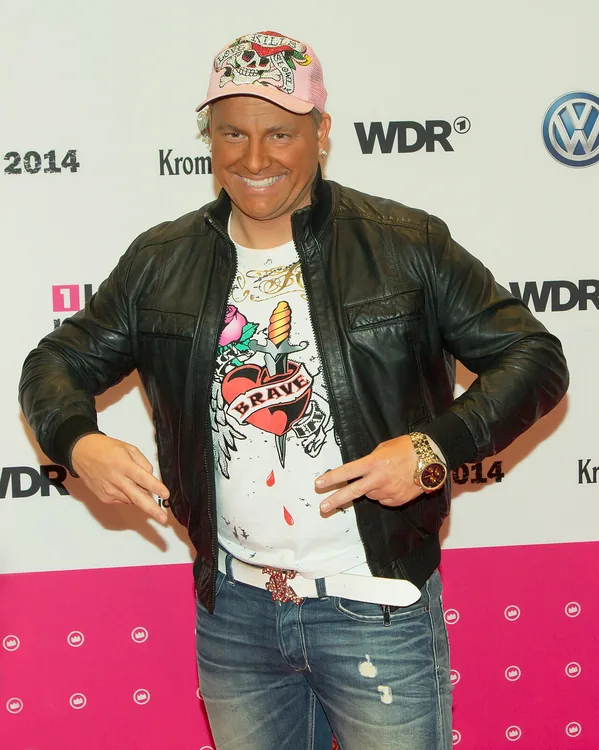
Andreas Obering, who Appears under the pseudonym Der Obel, works in Germany as a comedian, actor, musician and is also a member of local politics for the SPD.
Käthe Lachmann is a German comedian, stand-up entertainer, and author. Born on February 23, 1971, in Reutlingen, she spent her childhood at the foot of the Swabian Alb, growing up in Eningen near Reutlingen. Her upbringing involved outdoor activities like building huts, playing football, and roller skating. She moved to Hamburg after high school because she fell in love with the city and wanted to be far from her hometown. Initially studying philosophy for a few semesters, she has been performing as a comedian on stage for 20 years, influenced by comedy from Otto and Monty Python. Lachmann began her career in the early 1990s, presenting her first solo program, 'Esst mehr Obst,' in 1995. She quickly gained recognition through appearances on television shows such as 'Quatsch Comedy Club,' 'Ottis Schlachthof,' and the 'Harald Schmidt Show.' Her comedy style is known for portraying characters like Elke Schmitt, a voice actress with an exaggerated manner and naive charm, as well as parodies of Ottfried Fischer and Ulla Schmidt. She also claims to be the only person who can play the 'nasengitarre' (nose guitar). She won the NDR 2-Comedy-Preis in 1996 and the Publikumspreis at the Prix Pantheon in Bonn in 1999, receiving multiple awards including for her character Elke Schmidt. Her programs include 'Moussaka im Wigwam' (1998), 'Andere lassen sich piercen' (2001), and 'Sitzriesen auf Wanderschaft' (starting in 2002), which she regularly toured throughout Germany. While Lachmann achieved considerable success with shows like 'Ein zweigleisiges Pferd' (2007-2010) and the best-of program 'Ten Years Laughter' (2006), she has faced significant challenges with anxiety. She struggled with panic attacks for years, eventually withdrawing from the stage in 2015 due to an anxiety disorder, cancelling a show in Brühl and considering stopping her comedy program entirely. She is currently undergoing depth psychological therapy, practicing mindfulness techniques, and taking anxiety-reducing medication, with the goal of eventually being without medication. Despite retiring from performing on stage, she now appears in readings, talk shows, and interviews, openly discussing her experiences with anxiety disorders, as seen on 'Der Kölner Treff.' Her recent book, "Keine Panik, liebe Angst," released approximately one week prior to the article's publication, details these experiences and has been described as helpful by some readers. She is 46 years old and identifies more as a motivator than an advisor.
Mark Britton, born on September 17, 1958, in Rinteln, Lower Saxony, is a British comedian and actor currently residing at 68 years old. He spent his formative years in Basingstoke, England, as the son of an English psychoanalyst and an American actress. After completing school, he initially pursued acting, working at the Brighton Theatre Royal for two years. This early experience, coupled with subsequent studies in acting, pantomime, and clowning in London and Paris, laid the foundation for his future career in comedy. He also spent a year teaching English in Sudan, demonstrating a diverse range of professional pursuits before fully committing to the arts. Britton’s comedic journey took off in 1984 when he co-founded the comedy duo Nickelodeon with Krissie Illing. Nickelodeon toured internationally before settling in Germany in the early 1990s, during which time Britton wrote pieces like 'Christmas Dinner for Two' and 'Great Lovers in History'. In 1995, he transitioned to solo stand-up comedy tours in Germany, launching his first program, 'Comedy Solo.' His later programs, such as 'Apachen à Go-Go' (1998) and 'Wildlife' (2005–2008), blended stand-up with elements of theater and visual theater. He also presented 'Ein Englishman in Köln' (2005-2006), a program combining reading and stand-up, and toured with '3 Gentlemen' (2006) alongside Steve Rawlings and Ken Bardowicks. Britton’s work has included writing the play 'Heaven,' which premiered in 2000, and co-writing and directing 'Ein Feierabend für Eltern' in 2008. Britton’s current work focuses on a cabaret style combined with British stand-up, exemplified by his ongoing program 'Zuhause bei Britton' (2009 onwards). He is also known for his solo show, "Apatschen á Go-Go - A Comedy über Sex, Drugs und Staubsauger," which features characters Mark, Gary, and Janis who grew up in Basingstoke. This show, performed at the Renaissance Theater, portrays scenes from their lives between ages six and thirty-six and includes elements of pantomime. He portrays all three main characters and utilizes minimal props, relying on mimicry, gestures, sound effects, and improvisation. After a career spanning over 30 years in theater and television, Britton now works at the GHS in Zülpich as an MPT, developing and leading workshop courses combining psychology, theater workshops, and performance techniques. Publications include 'Ein Englishman in Köln' (2004) and 'Forever Jungs' (2014), demonstrating his versatility as a writer and comedian.
Martin Klempnow is an actor, comedian, presenter and voice actor working in Germany. In 2009, he became the Representation of Dennis from Hürth in de r broadcast Switch reloaded known to a larger audience.
Martin Rassau is a German cabaret artist and comedian from Franconia (Franken), born on January 3, 1967, in Fürth. He grew up there and currently resides there. Initially, he considered himself a competitor to Volker Heißmann, but they later formed a successful partnership. Rassau frequently performs with Volker Heißmann as the duo 'Heißmann & Rassau,' known for their humor rooted in everyday life. Their style is mainly rough and uses the Franconian dialect, often with fast humor, appeal, and poking fun at themselves. From 1996, they appeared regularly on local radio as ‘Die Kaltengrubers’ (The Cold Mine), performing comedic skits. They are also recognized for portraying characters like Waltraud and Mariechen, particularly in the 'Fastnacht in Franken' show since 1997. Rassau has collaborated with Bernhard Ottinger, exploring themes such as men experiencing midlife crises in the program "Kerle auf Kur - Männer, Schnupfen und andere Wehwechen," which features them exploring the topic of suffering men. Rassau is a theater entrepreneur; he and Heißmann opened a small stage in Nuremberg in 1991 and shortly after established the Kleine Komödie Fürth (small comedy theater) with 280 seats. In 1998, they founded the Comödie Fürth theater in Fürth. They produced and distributed the comedy film ‘6 auf See’ (6 at Sea) in 2000. From 2006 to 2015, they were a regular part of the 'Musikantenstadl' show with Andy Borg. Rassau has received numerous accolades, including a special award at the first Bavarian Dialect Prize in March 2017 and the Bavarian Order of Merit on June 27, 2018. They were appointed Cultural Heritage Ambassadors of Bavaria in 2018. In 2024, Rassau and Heißmann will receive the Karl-Valentin-Order from the Munich Carnival Society Narrhalla.
Matthias Egersdörfer, born December 28, 1969, in Nuremberg, Germany, is a multifaceted German artist working as a cabaret artist, comedian, actor, musician, and writer. He grew up in the Nuremberg area and now resides in Fürth. His background includes extensive academic study; he pursued degrees in German studies, theater studies, and philosophy. Additionally, he studied painting at the Nuremberg Academy of Art, graduating as a master student under Peter Angermann. Egersdörfer’s career began to take shape in 2003 when his short film 'Der Schüler' received the German Short Film Award. He launched his first solo program, 'Der Alleinunterhalter,' in 2004 and subsequently collaborated with Heinrich Filsner on the stage program 'Mündlich' in 2005. Since 2006, he has been a regular performer at the Quatsch Comedy Club. His solo programs 'Falten und Kleben' (2007) and 'Ich mein’s doch nur gut' (2010) garnered significant acclaim, earning him awards such as the Hamburger Comedy-Pokal, the Jury Prize at the Großer Kleinkunstfestival, and a Nuremberg scholarship in 2008. He has also received the Bavarian and Austrian Cabaret Prizes, and the Wolfram-von-Eschenbach-Preis in 2024. Beyond his solo work, Egersdörfer is known for his involvement with the band Fast zu Fürth, which combines comedy and music, and his collaboration with the folk band Gankino Circus since 2017. He has also appeared in the Franconian "Tatort" series between 2015 and 2022 as Michael Schatz, the head of forensic science. His artistic explorations extend to literature, with the publication of his first novel, 'Vorstadtprinz,' in 2019. His performances are characterized by a verbal style that exposes hypocrisy, prejudices, and misanthropy, often blurring the lines between reality and fiction. He is currently preparing a new program called "langsam" (slowly), which will premiere in April 2025 at 'Die Sünde' in Weiden, emphasizing slowness in both speech and storytelling. He is also scheduled to give a talk about art and learning on July 3, 2026, at the Germanisches Nationalmuseum in Nuremberg.
Matthias Jung is a German comedian and author. Born on June 16, 1978, in Bad Kreuznach, he grew up in Hüffelsheim. He is described as Germany's funniest youth expert and known as Germany’s ‘funniest puberty expert.’ Jung holds a diploma in Pedagogy (Diplom-Pädagoge), which informs his work. He began his stage career as a cabaret artist in 2005, and his stage career officially started in 2006. His comedy style combines experience, expertise, and pointed humor. From 2014 to 2015, he hosted a daily comedy series on Radio RPR1. He released his first CD, 'Der Urlaubschecker,' in 2015, followed by 'Generation Teenietus' in 2016. He tours regularly, having toured with his 'Generation Teenietus' program in 2016 and currently touring with his 'Chill mal' program since 2018. Jung’s work focuses on family and puberty coaching, providing answers to questions that concern parents. His book 'Chill mal – am Ende der Geduld ist noch viel Pubertät übrig!' (Chill out - at the end of patience there is still a lot of puberty), published in April 2018, became a SPIEGEL bestseller and remained on the list for several months. We Won't Get Together That Embarrassingly Anymore – The Puberty Book for Parents) which was released in October 2019. He regularly appears on SWR programs and hosts the radio comedy 'Eltern fragen – Jung antwortet,' on SWR3. He is described as a 'guide to patience' closely related to everyday life, parents, and the adventure of puberty. His motto is "Chill mal. Lieber glücklich als perfekt!" ("Chill out. Better happy than perfect!"). He performs a poetry slam called “Deine Zukunft – Lach Dich Schlau!” at schools and moderates ‘Science Slams’ in various cities.
Max Giermann, born Maximilian Giermann on October 24, 1975, in Freiburg im Breisgau, is a German comedian and painter. His family has roots in Greifswald, though his paternal grandparents left East Germany in 1953 and settled in Bad Homburg. He earned his Abitur in 1995 from the Berthold-Gymnasium in Freiburg and initially aspired to study art. After leaving his hometown as a teenager, he moved to Berlin with ambitions to act and later direct. Giermann’s early training included studying media art in Karlsruhe, which he did not complete, and attending the Ernst Busch Academy of Dramatic Arts in Berlin from 1997 to 2001. During this time, he was trained as a clown by Georgo Peugot and performed with him as Max Million. Following Peugot’s death, Giermann led the Comedy Kids clown group until 2008. Since 2004, he has primarily focused on comedy. Giermann is known for his impersonations and parodies of numerous figures, including Stefan Raab, Dieter Bohlen, Johann Lafer, Sigmar Gabriel, Donald Trump, Klaus Kinski, Robert Habeck, and Karl Lagerfeld. He regularly appeared on the RTL show Frei Schnauze until 2022, when he resumed hosting it, and was part of the ProSieben show Switch reloaded from March 2007; that show received a Grimme Award in 2013. He hosted Granaten wie wir in 2009 and 2010, and toured with his live program Wer denn sonst?! in 2011 and 2012. Giermann has appeared on Harald Schmidt’s late-night show and the ZDF improv comedy show Durchgedreht! . He won the German Comedy Award as best actor in 2009, a Romy award in 2009, and the second season of LOL: Last One Laughing in 2021. He has also served as a judge on Die Puppenstars and hosted Einstein Junior . Rupert Marmelade IV in Die Gangster Gang . Giermann, who lived in Cologne until January 2024, now resides in Freiburg and is increasingly dedicating himself to painting, describing his artwork as abstract and non-representational.
Michael Altinger is a German cabaret artist and musician, born in Landshut on November 20, 1970. Known for his mischievous and playful nature, he observes everyday life and finds humor in people's actions and words. Altinger’s comedy style is socially critical, self-ironic, and musical, often involving music with collaborators like guitarist Andreas Rother. Throughout his career, Altinger has been involved in various television and stage productions. From 2000 to 2011, he was an actor and author in the comedy series 'Die Komiker des Bayerischen Rundfunks.' He was an ensemble member of the Münchner Lach- und Schießgesellschaft from 2002 to 2003, and has appeared in smaller roles in TV series such as 'Die Rosenheim-Cops,' 'München 7,' and 'Der Kaiser von Schexing.' He has toured with Alexander Liegl under the program 'Tote zählen keine Schafe' in 2008, and presented the program 'Platzende Hirsche' with Liegl that same year. From April 2008 to July 2012, he hosted 'Altinger mittendrin' on Bavarian Television. Since May 2012, he has been a regular guest on 'Ottis Schlachthof,' and co-hosted the successor show 'Schlachthof' from March 2013 with Christian Springer. Altinger’s current stage program is called "Die letzte Tasse Testosteron." He performs “schlachthof” monthly at the Schlachthof Munich, where recordings take place on Tuesdays. Tickets for "schlachthof" cost €29.50 in advance and €35.00 at the door. He has received awards including the Passauer Scharfrichterbeil and the Bayerischer Kabarettpreis. Since July 2023, he has been hosting the podcast 'Rampensäue, frisch geschlachtet!' with Alexander Liegl. A new TV show, "ALTINGER," will premiere on October 15, 2026, at 22:00 on BR Fernsehen, featuring interviews with prominent guests, a look at the week in Bavaria, sketches, and music from the Altinger band. He has been co-hosting the BR show "schlachthof" with Christian Springer since 2013, and hopes to achieve ratings comparable to the 1980s show "Wetten, dass ..?".
Olaf Böhme, a cabaret artist and actor, was born in Dresden on September 23, 1953. A defining figure in his work was "The Drunk Saxon," also known as "Der Betrunkene Sachse." Böhme is considered a significant part of Saxon cultural history and a popular cabaret artist in Dresden. He lived in Klipphausen-Kleinschönberg near Dresden from 2001. Böhme’s early life demonstrated an aptitude for mathematics; he earned his Abitur in 1972 and participated in the International Mathematics Olympiad three times, winning two silver and one bronze medal. He studied mathematics at the Technical University of Dresden and in Kyiv from 1972 to 1978, eventually obtaining a doctorate in probability theory in 1983. Beginning in 1980, he also started writing poetry and short prose. From 1985 to 1990, he engaged with the free theater and film scene through the 'Spielbrett' group, and from 1996 to 1996, served as director of 'theater 50' in Dresden. He made short films with Stefan Martin starting in 1988. Böhme gained recognition as a cabaret artist, particularly through the character of “The Drunk Saxon,” featuring in solo programs like "20 Years of The Drunk Saxon" in 2011. He also created other programs and stage plays exploring his perspective on life, and wrote 'Herrn Pichmanns Gedichte' for Stephan Uhlig. He directed the film 'Treffpunkt Kronentor – ein Stadtrundgang mit dem betrunkenen Sachsen' in 2008, and collaborated with Stefan Martin and Clemens Hübner on the experimental film 'FRAUEN' (2009), followed by 'Ich schaue Dich an' in 2011. He regularly performed at the Boulevard Theater Dresden since its opening, cultivating a long-standing collaboration and friendship with them. Böhme was diagnosed with chronic lymphocytic leukemia in early 2008 and received a stem cell transplant in May 2012. His legacy continues to support children, particularly those with cancer, through projects like "Haus Sonnenstrahl."
German broadcasters and radios have featured the performances and work of comedian and musician Olaf Schubert. Born Michael Haubold in Plauen on November 7, 1967, he now operates under the stage persona of Olaf Schubert. He has a long history of musical involvement, including playing drums in Dekadance until 2013, and performing as Michael Rock in the band 'Die Rockys'. Schubert also previously performed as Gabi Schubert, Olaf Schubert's sister, until its dissolution. Schubert’s career began with the release of his debut album 'Bestandsaufnahme – Songs after Die Wende' in 1991. Between 1995 and 2000, Olaf Schubert released a series of albums: 'Hier bin ich!' (1995), 'Gefühl gewinnt!' (1996), 'Ich bereue nichts!' (1998), 'Bestandsaufnahme' (1999), and 'Echte Menschen' (2000). He is known for his wordplay and portrays himself as a self-assured know-it-all, often appearing in a knitted Argyle pullover and with a shaved head. His comedy style encompasses variety and cabaret, and he frequently performs with the formation 'Olaf Schubert und seine Freunde,' which includes Bert Stephan and Jochen Barkas; Bert Stephan plays bass, trumpet, and sings, while Jochen Barkas plays guitar and sings. Throughout his career, Olaf Schubert has received numerous awards and recognition. He was awarded the Salzburger Stier award in 2004 and the St. Ingberter Pfanne award in the same year. Further accolades include the Thüringer Kleinkunstpreis (2005), the Das große Kleinkunstfestival – Berlin-Award (2006), and the Deutscher Comedypreis for Best Newcomer (2008). He has also received multiple Deutscher Comedypreise as a member of 'heute-show' from 2009 to 2013, along with Deutscher Fernsehpreise in 2010 and 2014 for his involvement with the same show. Since 2015, he has been the patron and host of the Humorzone Dresden festival. Currently, he hosts a regular column, 'Mahner und Erinnerer', on SWR3 radio and co-hosts the show Das Gipfeltreffen with Torsten Sträter and Johann König. He also presents Olafs Klub on MDR since 2019.
Paul Beckers, ein deutscher Komiker unter dem Künstlernamen „Fliegentüten‑Heinrich“, war zudem als Schauspieler tätig und wirkte in mehr als 35 Kinoproduktionen zwischen 1917 und 1936 mit.
Albania
1
Armenia
1
Argentina
24
Austria
28
Australia
22
Azerbaijan
1
Belgium
13
Bulgaria
31
Benin
2
Bolivia
1
Brazil
12
Canada
48
Switzerland
17
Chile
8
Cameroon
1
China
7
Colombia
2
Czech Republic
7
Denmark
17
Dominican Republic
1
Algeria
2
Estonia
5
Egypt
4
Spain
74
Finland
15
France
211
United Kingdom
148
Ghana
3
Greece
18
Guatemala
1
Hungary
7
Indonesia
8
Ireland
20
Israel
9
India
11
Iraq
3
Iran
6
Italy
136
Jamaica
1
Japan
35
Kenya
3
Korea, South
20
Kazakhstan
1
Lebanon
5
Latvia
1
Morocco
17
Myanmar
1
Malta
1
Malawi
2
Mexico
28
Malaysia
7
Nigeria
19
Nicaragua
2
Netherlands
2
Norway
12
Nepal
3
New Zealand
9
Peru
2
Philippines
35
Pakistan
7
Poland
8
Portugal
7
Qatar
1
Romania
1
Serbia
3
Russia
9
Saudi Arabia
4
Sweden
101
Slovenia
4
Slovakia
2
Thailand
2
Tunisia
4
Turkey
5
Taiwan
1
Ukraine
1
Uganda
7
United States
213
Uruguay
1
Uzbekistan
1
Vietnam
1
South Africa
2
Germany has a diverse comedy culture that includes stand-up, Kabarett, sketch comedy, television, film and live stage performances. German comedians work across many different styles, from observational humour and satire to character comedy, storytelling and improvisation.
GiggleTime's directory brings together German comedians, stand-up comedians, comedy actors, cabaret performers and other personalities from the world of German comedy. Browse the profiles above to discover comedians from different generations and learn more about their careers and performances.
Stand-up comedy has become an increasingly popular part of entertainment in Germany, with comedians performing in comedy clubs, theatres, festivals and other live venues.
German stand-up covers a wide range of subjects and styles. Performers may draw material from everyday life, relationships, work, cultural differences and personal experiences, while others focus on satire, social observations or deliberately absurd humour.
Berlin, Hamburg, Cologne and Munich are among the cities with active comedy communities, but German comedians perform throughout the country. The growth of comedy clubs, touring shows and online platforms has also created more opportunities for new performers to reach audiences.
One of the most distinctive parts of German comedy is Kabarett, a form of performance traditionally associated with political and social satire.
Kabarett performers often use humour, irony and commentary to examine current affairs, society and everyday life. Although Kabarett has its own traditions and style, modern German comedy includes many performers who move between different formats, combining elements of cabaret, stand-up and theatrical performance.
This long-standing tradition gives German comedy a particularly broad range, from light entertainment and observational humour to more satirical performances.
Television has played a major role in making German comedians familiar to large audiences. Comedy series, sketch programmes, panel shows, late-night formats and entertainment programmes have provided platforms for performers from different backgrounds.
German comedians and comedy actors are also active in cinema, theatre and voice acting. Some performers have built careers primarily through television, while others began with live comedy before moving into acting, writing or presenting.
Germany's entertainment industry also includes performers from different regions and cultural backgrounds, contributing to the variety of voices found within contemporary German comedy.
German is the main language of the country's comedy scene, but German-language comedy also reaches audiences in Austria, Switzerland and other parts of the German-speaking world.
At the same time, digital platforms have made it easier for German comedians to reach international audiences. YouTube, podcasts, social media and streaming services allow performers to publish sketches, stand-up clips, interviews and other comedy content without relying solely on traditional television or live venues.
This changing media landscape has helped introduce a new generation of German comedians to wider audiences.
Looking for German comedians, German stand-up comedians or comedy performers from Germany? Explore the GiggleTime directory above to discover comedians working across stand-up, television, film, theatre and other forms of entertainment.
Use the search feature to find a particular comedian or browse the profiles to discover new performers. Individual profiles may include biographical information, career highlights, performances, photographs and other interesting details.
Whether you're interested in German stand-up comedy, Kabarett, comedy actors, television comedians or emerging German comedy talent, GiggleTime makes it easier to discover the people behind the humour.
The directory continues to grow as new German comedians and comedy personalities are added.