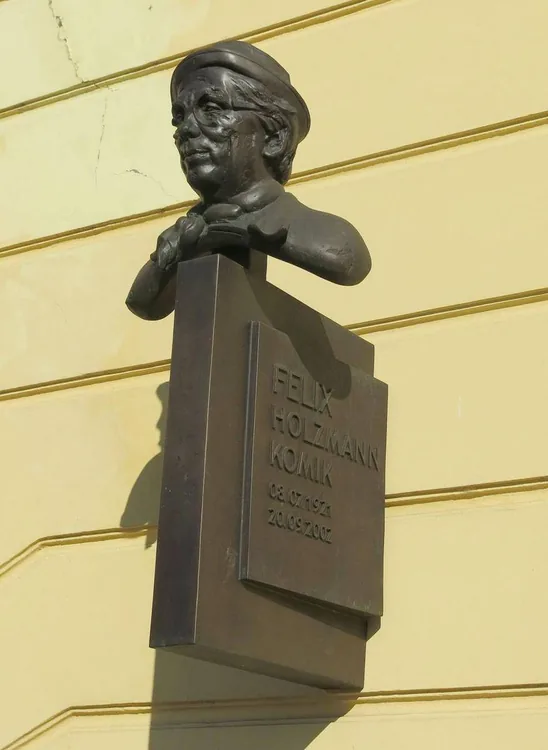
Felix Holzmann
A Czech comedian and screenwriter, Felix Holzmann, was born in Teplice, Czechoslovakia (now the Czech Republic) on July 8, 1921. He was of Czech-German parentage, and his family ran a business in Litoměřice, where he spent his early years. His father was German and his mother was Czech. Holzmann attended a commercial school in Ústí nad Labem before World War II. Holzmann’s life was significantly shaped by the events of the 20th century. At age 19, he was drafted into the Wehrmacht due to his family's declaration of German nationality and served in naval artillery during World War II. He experienced heavy bombing raids and was stationed in Gdańsk, Gdynia, Kiel, France, Estonia, and Latvia. After being captured by the Red Army in May 1945, he spent a year in a Soviet gulag. Following his release, he returned to Czechoslovakia and began performing on variety stages in the early 1950s. He developed a distinctive style known for wordplay humor, a unique way of speech, and a recognizable appearance, often wearing a straw hat, neckerchief, and horn-rimmed glasses on stage. Holzmann’s comedy frequently involved precisely-structured dialogues full of wordplay and often featured the character of a slow-witted man. He collaborated extensively with František Budín, forming a long-term stage partnership, and also worked with other prominent figures like Lubomír Lipský, Iva Janžurová, Miloslav Šimek, Karel Gott, and Viktor Maurer. He appeared in several films and TV shows, including 'Deset malých běloušků' (1993) and 'Buďte pozdraven, pane Jouda!' (2006), and frequently performed in televised New Year's Eve shows as the confused 'Mr. Jouda'. Holzmann married Eva Vorlíčková in 1968 after living together for two decades; she committed suicide in 1970, deeply affecting him. Barbara Greif, a German actress and singer, became his wife later, and they often toured together. Felix Holzmann died on September 13, 2002, in Chemnitz at the age of 81, and is remembered through a bust and memorial plaque in Litoměřice.