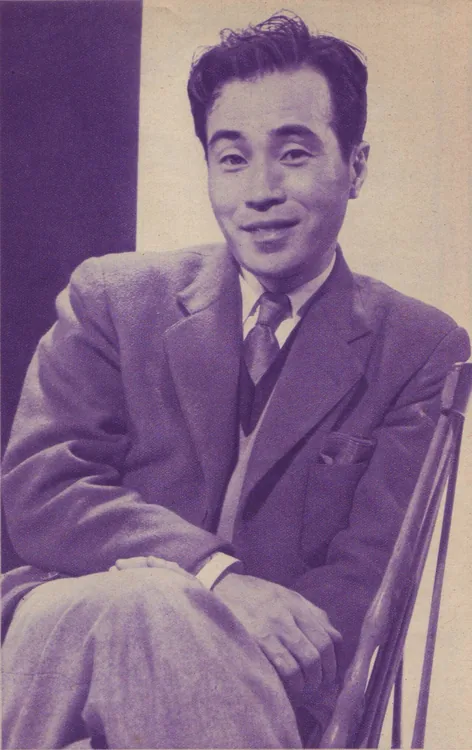
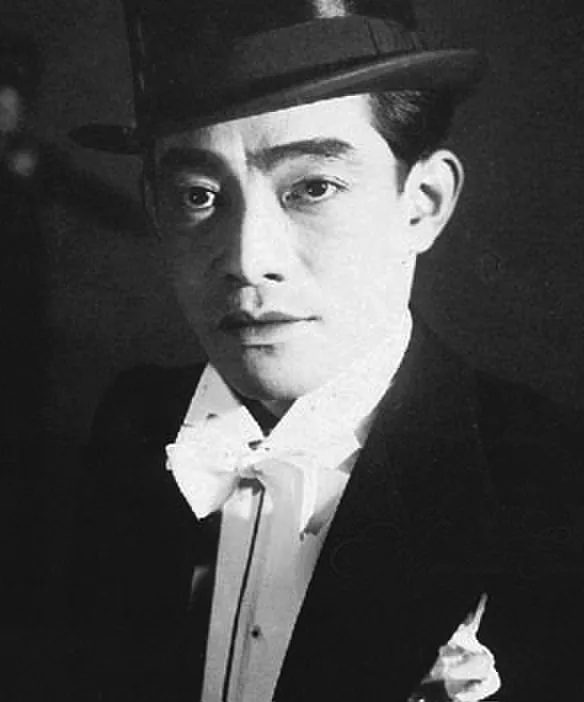
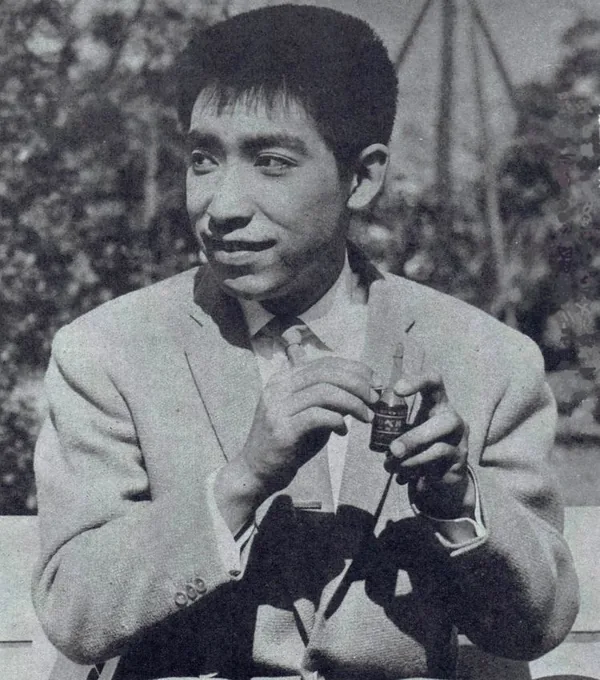
Japanese comedian, actor, and singer Enoken (エノケン), born October 11, 1904, in Tokyo’s Aoyama district, was widely known across Japan. His given name was 榎本健一. He began his career on the stage in Asakusa in the 1920s, initially as a chorus boy in the opera 'Carmen' in March 1922 at the Kinryu Hall. From 1919, he was an apprentice to actor 柳田貞一 at the 'Konishi Grand Opera'. His parents owned a rice cracker shop, and an impromptu act of eating rice grains like a monkey around 1923 led him to pursue comedy. Enoken’s comedic style combined singing, dancing, acrobatics, and ad-libs. He significantly influenced Tokyo theatre before World War II through his stage shows, radio appearances, and film roles. Following the Great Kantō earthquake in 1923, he shifted his focus to comic theatre and performed comedic skits with friends in Kyoto. He joined the Casino Folies troupe in 1929, gaining popularity for its fast-paced and nonsensical humor, and briefly founded 'Casino-Fourlee' that same year. In 1930, he launched his own troupe, Enoken Gekidan. He starred in Enoken no Seishun Suikoden in 1934, directed by Kajirō Yamamoto, gaining national popularity, and later appeared in the first talking film, Enoken no Seishun Suito-den (1940). He collaborated with directors Kajirō Yamamoto, Nobuo Nakagawa, and Akira Kurosawa on films, including appearing in Kurosawa's Tiger Tail . His energetic movements on stage were a hallmark of his performances. Enoken continued to be a popular comedic actor throughout the pre- and post-World War II periods, often starring in historical drama and samurai drama films, parodying Japanese historical figures like Kondō Isami and Sakamoto Ryōma. He also appeared in other notable films such as Enoken no Chakkari Kinta , Enoken no Hokkai-bo , and Son Goku . He recorded many songs for Polydor, covering popular jazz songs and foreign tunes with altered lyrics. He was considered "The King of Comedy," and his era was often referred to as 'Enoken-Ryūpa' alongside Kokawa Ryūpa. He received the Purple Ribbon Medal in 1960. Unfortunately, necrosis of his right leg in the 1950s led to amputation and curtailed his career, although he made a comeback at the Shinjuku Koma Theater in 1963 with a prosthetic leg. He died on January 7, 1970, from liver failure at the age of 65, following a stroke caused by being defrauded during a tour of Taiwan. His contributions to Japanese entertainment are preserved in the NHK Archives.